
Werewolf of London was released six years before Lon Chaney Jr. starred in The Wolf Man (1941) and seems to have suffered ever since. The first werewolf movie in Universal’s horror cycle, Werewolf of London stars Henry Hull as the botanist Dr. Wilfred Glendon. It shares many elements of other Universal horror films such as opening on an expedition similar to The Mummy (1932); the buzzing and electrical flashes of Glendon’s lab that recall the Frankenstein films; and the comedy relief of a slumlord duo, Mrs. Moncaster (Zeffie Tilbury) and Mrs. Whack (Ethel Griffies), that seem to add up to one Una O’Connor romp, in—take your pick, but The Invisible Man (1933) is the one that came to my mind.

Henry Hull
Another reason Werewolf of London takes a historical hit when compared to other Universal horror outings is the absence of horror legends Boris Karloff and Bela Lugosi. Among hard core horror fans this hurts a bit more because both were at one time associated with the project. Lugosi was actually assigned the Dr. Yogami role which eventually went to Warner Oland of Charlie Chan fame, while Karloff appears to have been less directly involved with this specific project but was to play the werewolf in a film proposed by Universal as early as 1932 (Weaver, Brunas and Brunas 130). But rather than Karloff and Lugosi we’ve got Henry Hull and Warner Oland, and that wouldn’t be such a terrible thing at all if the other possibility had never existed.

Henry Hull and Warner Oland
Hull’s Dr. Glendon leads an expedition in Tibet with the object being discovery of the rare Mariphasa plant which is said to take its life from the moon. A conversation with a holy man (Egon Brecher) convinces Glendon that they’re close to finding it. “You are foolish, but without fools there would be no wisdom,” he tells Glendon and his assistant (Clark Williams) as they bid him farewell to ascend the Tibetan mountainside. Along the way they’re awkwardly blocked by some sort of invisible force which almost physically wills them to turn back. But Glendon spots the rare plant through his binoculars and forges ahead. A shadowy figure looms above him and then, with just a hint of what lies behind the shadow for the viewer, attacks and bloodies Dr. Glendon.

Back home in London we meet Glendon’s wife, Lisa, played by Irish born actress Valerie Hobson, whose long and lean appearance reminded me a little of Ann Dvorak. Lisa loves her husband, but potential discord is on the scene in form of her childhood friend Paul Ames (Lester Matthews), who one time had proposed to Lisa; when he was 12 and she 6. Lisa reminds her distracted husband that they’re hosting a party that evening and he’ll have to pull himself from the lab. Glendon apologizes telling her, “I promise you, my dear, as soon as I complete that experiment I’ll try to be more, well, more human.” The scars on his arm tell us this isn’t very likely.
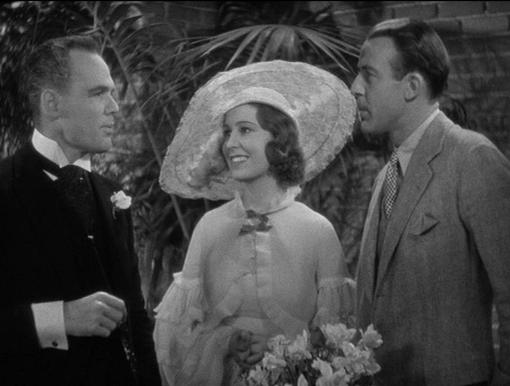
Henry Hull, Valerie Hobson and Lester Matthews
An uninvited guest arrives at the party, one Dr. Yogami (Oland), who on the surface seems to just be very interested in botany. Dr Glendon asks, “Have I met you before sir?” to which Yogami mysteriously replies, “In Tibet once. But only for a moment. In the dark.” Puzzled Glendon asks “In the dark?” before allowing Yogami to interrupt him with questions about the mysterious flower. Yogami tells Glendon all about the Mariphasa, specifically how it is an antidote to werewolfery, or lycanthropy as it’s more properly known. “The werewolf is neither man nor wolf, but a satanic creature with the worst qualities of both,” Yogami tells him, but Glendon puts on airs and waves off both Yogami and his ridiculous story.

Of course, once hair begins sprouting across the back of Dr. Glendon’s hand Yogami’s story is hope for him to cling to. Following Yogami’s earlier instructions he snips a flower off of his Mariphasa plant and injects the stem into his hand. Hair be gone. While Glendon spends the evening reading up on lycanthropy (Interesting: if the werewolf does not kill at least one victim per night under the full moon his hairy affliction will then become permanent) an unseen but quite obvious intruder snips all of the flowers off of his prized plant down in the lab. And so when the moon shines and the hair begins to rise across his hand once more Glendon goes to grab one of the magic flowers only to find them all gone.

Wolf's Paw
Thus begins Hull’s first full transformation into the monster which actually recalled to me one of the more popular episodes of The Twilight Zone, “The Howling Man.” That television episode wasn’t made until 25 years after Werewolf of London, and the effect still works then making Hull’s turn into the werewolf even more startling.
Yogami has warned Glendon that the werewolf “instinctively seeks to kill the thing it loves best,” which puts Lisa directly in harm’s way. Lisa spends most of the film in the hands of childhood pal Paul, but Paul still carries a flame for her and Glendon picks up on it—not a good thing to make a werewolf jealous. But it just so happens that Paul works under his Uncle, Sir Thomas Forsythe (Lawrence Grant), at Scotland Yard, so when these mysterious wolf murders begin spreading across the London papers it’s Paul, who’s heard Glendon’s howling no so far off, who proposes lycanthropy as the cause. A visit to the precinct from Yogami further convinces Paul, who eventually guesses that not only is a werewolf responsible for the murders, but that Glendon is that werewolf. I’m not sure how Paul connected those dots, perhaps through wishful thinking born from his longing for Lisa, Glendon’s wife.

Spring Byington must have had a little too much to drink.
Werewolf of London includes some fine moments of horror beginning with Hull’s own discovery of what he has become followed by his unleashing his terror across the London night. While Jack Pierce’s make-up here isn’t as famous at that which Chaney Jr. donned six years later as The Wolf Man it is perhaps even more frightening.
Hull’s werewolf keeps his wits about him post-transformation so while as a werewolf he still has the intelligence to seek out the flower as antidote and is still human enough to grab his hat and scarf on his way into the cool London night. In this way he seems a near equidistant bridge between Fredric March’s Dr. Jekyll and Mr. Hyde (1931) and Chaney’s Wolf Man. This creates a nice contrast between the two werewolf films. Which scares you more, Chaney’s turn to uncontrollable animal, or Hull’s more reasoned but just as violent version of the werewolf?

Valerie Hobson and Lester Matthews make a nice couple in Werewolf of London, even if technically they’re not. Hobson, in particular, finds her character in a tough spot in between loving her self-obsessed husband and being loved by her childhood sweetheart. Lisa’s concern for Hull’s Wilfred Glendon overworking himself is sincere, while Glendon’s jealousy is spurred on by the disease that’s overtaken his blood. Wilfred makes several excuses for not attending to Lisa, more or less thrusting her towards Paul, and he seems to know it as his snide comments escalate throughout the movie. But even as we’re led to believe Paul may be winning over Lisa to his familiar charms her dialogue keeps her faithful to Wilfrid. This satisfies not only the Production Code, but the audience as well. Matthews, as Paul, manages to court the married Lisa without seeming sleazy. Their adult relationship seems to have been born of innocence and an outsider can’t blame him for becoming smitten with the girl he once loved after he sees her husband put her off time and again. Well done by both actors.

Happy times for Lester Matthews and Valerie Hobson
Warner Oland’s role is limited and he comes off as more sneaky than scary in creeping around Werewolf of London. He is very good in his first scene with Hull and later convincing when talking with Matthews and Lawrence Grant at Scotland Yard, but otherwise he’s just there without quite enough menace. Still as not an entirely dark character Yogami is interesting. His story may have turned out quite differently had Dr. Glendon listened to him.

Warner Oland
Werewolf of London was a Universal production directed by Stuart Walker who had worked with Hull the previous year in that same studio’s Great Expectations (1934). Werewolf of London was made during January-February 1935 at a cost of $195,000 according to Weaver and the Brunas’s in Universal Horrors
In the New York Times review published May 10, 1935 it was praised as being “Designed solely to amaze and horrify, the film goes about its task with commendable thoroughness, sparing no grisly detail and springing from scene to scene with even greater ease than that oft attributed to the daring young aerialist.” They also compared it with both Dr. Jekyll and Mr. Hyde and The Invisible Man.
Time Magazine found Werewolf of London “a shade sillier than The Bride of Frankenstein, more alarming for small children than Mark of the Vampire,” which doesn’t speak volumes for either this picture or Bride. In general, says Time, “Werewolves are not as eerie as vampires but they are faster, more ferocious and make uglier noises,” again mocking the genre, while at the same time drawing a pretty accurate comparison for the 1935 filmgoer who’s yet dared to view these horror titles firsthand.
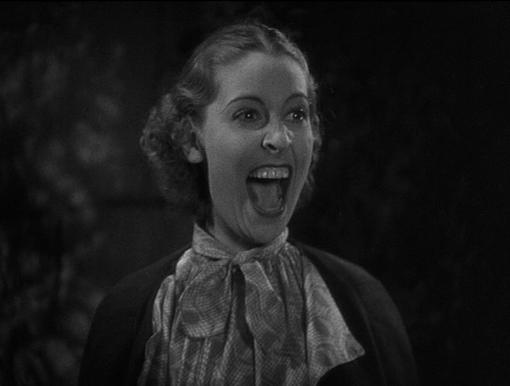
Valerie Hobson, less happier times
A more recent take is that of Weaver, Brunas and Brunas in Universal Horrors who write that “It’s poky, quaint and self-consciously theatrical. Although these restraints somewhat diminish the gut-wrenching human drama at the heart of the story, they don’t detract from the film’s considerable chills and beautifully sustained atmosphere” (130).
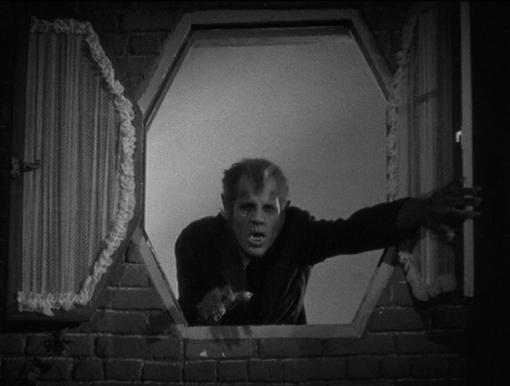
See you next time, Henry ... or maybe not.
I think that if Chaney Jr. has long been your only Wolf Man then you owe it to yourself to give Henry Hull a chance. He can be a bit of a jerk, but if wife Lisa can understand that’s because he’s working so hard then so should we. The story is creepy and filled with screams that can still shake you up from your couch. It doesn’t have the all-star supporting cast thrust around Chaney in the later movie, but you’ll know Hobson from another little horror film released the same year, Bride of Frankenstein, and Lester Matthews would next appear with Karloff and Lugosi in The Raven (1935). Give it a shot, if you like The Wolf Man and aren’t completely opposed to someone other than Chaney delivering the howls then you’ll enjoy this underrated classic.
Availability:
My copy of Werewolf of London comes as part of the The Legacy Collection

Sources:
- Weaver, Tom, Michael Brunas and John Brunas. Universal Horrors: The Studio’s Classic Films, 1931-1946
[phpbaysidebar title=”eBay Shopping” keywords=”Henry Hull,Warner Oland” exclude=”murder” num=”9″ siteid=”1″ category=”45100″ sort=”EndTimeSoonest” minprice=”39″ id=”2″]

A movie I try to watch on October 3rd, the shared birthday of Hull and Oland. Such milestones pass the year pleasantly.
I applaud the ladies, Griffies, Tilbury and Byington, for what they bring to the proceedings.
Ooh, I like that, I have to remember to do that next year! You know with all the books and web pages I had open before settling in to write this somehow I completely missed the shared birthday which I surely would have noted here. Neat bit of trivia, thanks!
An unknown factoid that horror fans may not know is that behind that wolf makeup in the fight scene (looking down from the rocks) between Henry Hull and the Werewolf in the mountains of Tibet, was Julius (Carl Jr.) Laemmle head of production at Universal Pictures, and son of Universal prexy Carl Laemmle.