
Sometimes one scene can save a stinker. That idea makes me think of what Edward G. Robinson did towards the end of Two Seconds (1932), but Robinson’s performance actually escalated over several scenes towards that closing crescendo, and Two Seconds is otherwise okay even before Robinson begins his spine-tingling finish. I didn’t feel the same way about The Woman Accused (1933).

Above: Cary Grant and Nancy Carroll in The Woman Accused
The Woman Accused stars two of my favorites, Nancy Carroll and Cary Grant, in what ranks towards the bottom of any list of films I might create featuring either one of them. But The Woman Accused does boast one scene to remember. Unlike Two Seconds this movie is not saved by an actor rising to the top of his craft and emptying his heart and soul for the camera. No, in the case of The Woman Accused it’s simply a few shocking seconds of violence that make you sit up and take notice.
It happens late in the movie when Cary Grant’s character—without any previous warning—pulls a rawhide whip from the inside of his jacket and beats the living hell out of Jack La Rue, who (as usual) deserves everything that he gets.

Above: Jack La Rue gets his.
Because of this scene I will probably never forget The Woman Accused, but otherwise I had better get down what took us to that moment, because that hour-plus is already slipping from memory. As Hollywood Reporter titled their review: “Para’s ‘Woman Accused’ Has Slow and Pointless Story.”
Nancy Carroll is Glenda O’Brien, whose lavish apartment is explained by a quick line identifying her as stage actress, presumably a successful one. Cary Grant plays her beau, Jeff Baxter, a lawyer who’s gathered Glenda’s friends in her spacious two-floor apartment to surprise her with a three-day cruise connected to a marriage proposal. Glenda has a past that she tries to confess to Jeff, but he won’t hear of it.
Glenda’s maid Martha (Norma Mitchell), who has all but raised her, is interrupted from dressing Glenda when the telephone rings. Martha is horrified the moment she hears the voice on the other end of the line; so too is Glenda. It’s Glenda’s ex, Leo Young (Louis Calhern), and he wants her back after having spent six months away in Europe. Leo has moved into the same apartment building, just two floors above Glenda, and threatens to come down and disrupt her party if she doesn’t come up to see him. Glenda tells Martha not to alert any of her guests to her absence and exits through her bedroom to set Leo straight.

Above: Louis Calhern and Nancy Carroll
But Leo won’t have any of her excuses: she belongs to him. He locks her inside his apartment and insists she take him back. Glenda tells him that she’s in love with another man and makes the mistake of naming him. Leo places a call to his pal Maxie (Jack La Rue), unable to contain his smug expression as he explains to Glenda that all he has to do is tell Maxie, “there’s a man I don’t like very much,” and, what do you know, that man then disappears. Glenda fights to stop Leo from telling the hit man Jeff’s name, but Leo shoves her away. Her hand happens upon a tall solid sculpture decorating Leo’s apartment, and before Glenda even knows what she has done, she’s cracked the piece over Leo’s skull. He’s dead.
Glenda is hysterical when she rejoins Martha in her own bedroom, but Martha tells her not to worry. She sends Glenda off with Jeff and the other youngsters for three days fun at sea. Meanwhile, Leo’s friends are beginning to wonder why he doesn’t answer his phone. Leo’s law partner Stephen Bessemer (John Halliday) can’t get through by phone—the receptionist even puts on “the howler” to try and get Leo’s attention (the howler is a loud tone that cries out from Leo’s phone). Maxie arrives at the apartment in time to see Glenda, Jeff, and company party their way through the lobby. The crowd departs just before Bessemer arrives to investigate for himself.

Above: John Halliday, up to no good again.
So far, standard stuff. But Bessemer takes an extreme interest in the case of his partner’s murder and convinces the District Attorney (Irving Pichel) that given enough rope he can hang the murder on Glenda. Sure, why not, the DA figures, and later that night Bessemer is taken by police boat to meet the ship. Things soon turn a bit crazy when Bessemer hosts a masquerade party on Captain’s Night and arranges for the mock trial of Glenda. Somebody seems to have forgotten the mock part of the trial though, and Bessemer positions a man out of view to transcribe all of Glenda’s testimony, which becomes especially damning after she cracks. And it doesn’t take much to crack her.
Once he has his evidence, Bessemer sends a wireless message back to the DA at shore: “Party has confessed. Arrange for arrest immediately upon arrival.”

Above: Halliday, Carroll, and Grant.
This all took sixty-three minutes to happen. At that mark Glenda, Jeff, Glenda’s maid, and Bessemer gather in the DA’s office with Bessemer pressing his case as if he had concrete evidence of murder. The topper comes when he calls in Maxie, or as Bessemer calls him, a “reputable witness,” to claim that he recognizes Glenda’s voice as the voice he heard protesting in the background when he spoke to Leo over the phone.
This (somehow!) looks bad for Glenda, who has admitted her guilt in front of over one hundred witnesses (most wearing clown costumes) and has been implicated by a shooter so square that he’s packing heat in the DA’s office. Jeff begs the DA to give him a half-hour to square everything away. Well, why not, anything goes by this point.
This is when the scene with the rawhide whip plays out. It’s worth remembering that The Woman Accused was based on a story serialized in Liberty magazine, which we’ll get to in a minute, so it is possible that the story provided some motivation for Jeff to own and carry a whip like this. If so, maybe screenwriter Bayard Veiller should have worked it in. The only thing the whip has going for it is that it’s used immediately after we first see it, and its use is so shocking that you don’t have time to wonder where it came from until later.

Above: Jack La Rue, reputable guy. With Cary Grant.
There is one other memorable, or at least noteworthy, aspect of The Woman Accused, but unfortunately it’s over by the time my DVD ticks a little past one-minute into the film. The ten all-star writers who had a hand in the original story are each pictured in the opening credits before any of the actors are even shown. While I already knew what Irvin S. Cobb and Zane Grey looked like, it was a pleasure to put faces to the names of the other eight writers, all popularly read at the time of the film. I’ll introduce you to their mugs in a minute, but first a little more background on this case of too many chefs concocting a dish best served sparingly, if at all.
From what I gather, the idea of a story by ten prominent writers originated with one of the ten, Polan Banks. Banks at least originated the original title of this tale, Passage to Paradise. Paramount bought screen rights in November 1932, before the story was even published, and both Nancy Carroll and Cary Grant were cast before the end of that same month. The story ran in Liberty over five installments, each by two writers, beginning January 21, 1933, and extending through February 18, a day after the film released.
As for the shots of the writers shown in the opening credits, Hollywood Reporter, ahem, reported that three of the writers were filmed in Hollywood, five in New York, one in San Francisco, and that Paramount had Zane Grey send along his own footage from the South Seas. I’m not sure where Gertrude Atherton counts among those numbers since she is shown in illustration rather than on film.
The critics savaged The Woman Accused, and I can’t blame them.
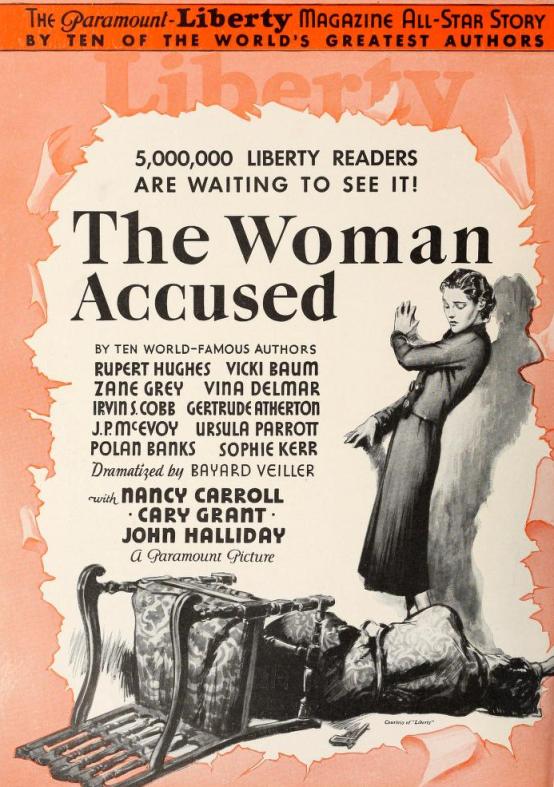
Above: Trade advertisement for The Woman Accused, Motion Picture Herald, February 11, 1933.
Cary Grant received some compliments, but most of the praise went to Jack La Rue with more than one source hoping Paramount would give him more to do in the future.
I don’t know if I agree with the sentiment based upon this particular movie, but Hollywood Filmograph could have had a crystal ball when it said, “Cary Grant proves himself capable of handling a leading man’s laurels.” Grant’s good, but the problem is that he’s at his best during the movie’s most ridiculous scenes, from the mock trial forward.
La Rue is good too, plenty of menace bakes through his clenched teeth, and he can smile in a way that makes you want to punch him.
Nancy Carroll, I love her, but not here. She is way over the top in a performance filled with hand-wringing, eye bulging, and other histrionics.
La Rue’s whipping did not go unnoticed. “Wearisome patchwork,” said the New York Post, “unrelieved by anything of interest until some one who wrote the last episode decided to give it a punch.” The New York Herald-Tribune found the movie “amusing only in a scene wherein the hero flogs one of the subsidiary villains, and then only mildly so.” A little more flavor came out of Motion Picture Herald’s report from the Hollywood preview:
“Biggest scene in the picture is the horse-whipping of a gangster … to make him tell the truth. It evoked two big bursts of applause from the preview audience.”
I’m surprised they were awake. It took me two tries. And now, those writers responsible for this piece ultimately adapted by Bayard Veiller and directed by Paul Sloane:

Rupert Hughes, Part 1 in Liberty, January 21, 1933.

Vicki Baum, Part 1 in Liberty, January 21, 1933.

Vina Delmar, Part 2 in Liberty, January 28, 1933.

Irvin S. Cobb, Part 3 in Liberty, February 4, 1933.

Gertrude Atherton, Part 3 in Liberty, February 4, 1933.

J.P. McEvoy, Part 4 in Liberty, February 11, 1933.

Zane Grey, Part 2 in Liberty, January 28, 1933.

Ursula Parrott, Part 4 in Liberty, February 11, 1933.

Polan Banks, Part 5 in Liberty, February 18, 1933.

Sophie Kerr, Part 5 in Liberty, February 18, 1933.
The Woman Accused is one of five movies released to home video for the first time in the eighteen-film Cary Grant: The Vault Collection released by Universal Studios Home Entertainment in April 2016. I’d love to see Universal release a similar Nancy Carroll collection. Won’t hold my breath waiting though.
When I went looking for other coverage of this title I couldn’t find too much, and what there was is a few years old. Danny seemed equally unimpressed at Pre-Code.com, while shadowplay found more to like about it. I was tempted to nail it with a 5/10 rating, but added an extra half-point for dropping my jaw a few times. Impressive sets too. Can’t say I hated it, but recalling Hollywood Reporter’s review, I found The Woman Accused more pointless than slow.
References
- “Big—And Not So Big.” Motion Picture Herald, February 4, 1933, 27.
- “Dad Says.” Hollywood Filmograph, November 5, 1932, 4.
- “Dad Says.” Hollywood Filmograph, November 26, 1932, 4.
- Forde, Arthur. “As Seen and Heard.” Hollywood Filmograph, October 29, 1932, 5.
- “New York Reviews: The Woman Accused.” Hollywood Reporter, March 15, 1933, 2.
- “Para’s ‘Woman Accused’ Has Slow and Pointless Story.” Hollywood Reporter, January 28, 1933, 3.
- “Ten Writers Filmed For Use In Para. Picture.” Hollywood Reporter, January 7, 1933, 1.

Impressive sets, eh? Well, like they say, nobody ever left a show whistling the sets. Actually, I find myself often remembering sets when plot and actors start to fade away. Must have a thing for furniture.
Happy New Year!
Nancy Carroll had an incredible apartment: Glenda must have been quite the successful actress! I guess it also earned that extra half-point for actually prompting me to write about it.
I unfortunately never watched that one… I’ll look up in YouTube or in Archive.org …